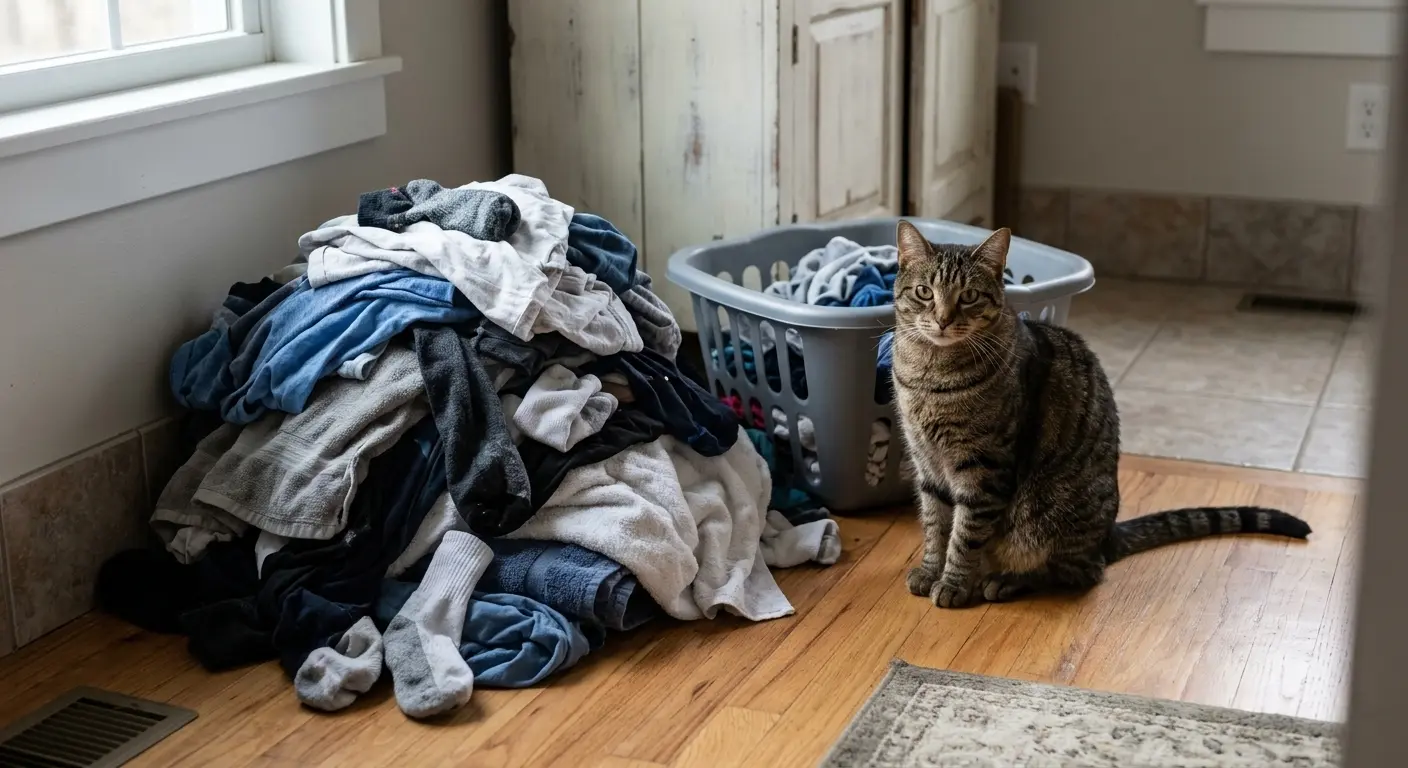

Cat peeing on clothes is one of the most searched litter box complaints among cat owners, and for good reason: it can point to anything from a simple fix to a medical emergency
The simple answer is that there is either a medical problem, a malfunction in the litter box, or the cat is upset. There are three possible causes, and it always ends up being one of them.
It’s not malice. Cats don’t think about that. But even knowing that, when you see your favorite clothes soaked in urine, it still makes you angry, doesn’t it? I do too. I’ve had cats my whole life, and I’ve had this problem myself.
At a Glance: 7 Causes and What to Do First
| Cause | Quick Signal | First Step |
| Medical problem | Sudden onset, straining, crying, blood in urine | See a vet immediately |
| Dirty/wrong litter box | Peeing near the box, not just on clothes | Clean daily, add a box |
| Scent bonding | Targets one person’s clothes only | Add a Feliway diffuser |
| Stress | Started after a house change | Reduce triggers, give safe space |
| Territory marking | Small amounts, vertical surfaces | Consider spay/neuter |
| Texture preference | Always soft piles, any location | Remove access to soft piles |
Why does my cat pee on my clothes? 7 real causes
Before going through your specific case, it helps to understand why do cats pee on clothes in general. Almost every case comes down to one of three root issues: a medical problem, a litter box issue, or emotional stress. The seven causes below break these down in detail.
1. A medical problem is the most likely starting point
.
When there is pain when urinating such as with an infection, cystitis, or stones the cat thinks the litter box is the cause of the pain. She thinks, “This place hurts, find another place.” And then she looks for a soft, safe place a pile of your clothes. Clothes on the floor are soft, absorb urine, and don’t feel like a litter box.
Common medical causes:
- Urinary tract infection (UTI) — pain, frequent urination, straining, and sometimes crying while urinating.
- FLUTD (Feline Lower Urinary Tract Disease) — inflammation, obstruction, and bladder discomfort. This can be life-threatening in male cats . if your male cat is straining and nothing is coming out, seek emergency veterinary care immediately.
- Bladder stones or crystals — painful urination, sometimes with blood.
- Kidney disease or diabetes — excessive thirst, excessive urination, and not making it to the box in time.
- Arthritis in older cats — makes climbing into the litter box difficult, so they look for a soft spot nearby instead.
A study published in the American Journal of Veterinary Research in 2025 also found that cats with inflammatory diseases change their urinary habits. So if the peeing on clothes is new and sudden see a vet first, then any behavioral solutions.
2. The litter box is the problem, not the cat
But cat behavior consultant Ingrid Johnson is blunt: Cats pee outside the litter box when something is wrong and a bad litter box situation is one of the most common reasons.
Your cat isn’t going to the litter box because:
It’s not cleaned frequently, cats are notorious for being picky eaters, refusing to let their litter box get dirty.
- It isn’t cleaned often enough — cats are famously picky about a dirty box.
- The box is too small, making it hard to turn around in.
- The litter type is wrong — heavily scented or coarse litter is a common trigger.
- The location doesn’t feel safe — too open, or another pet could ambush them there.
- There aren’t enough boxes — the standard rule is one box per cat, plus one extra.
The solution is systematic.
Clean the box once or twice a day. If you have more than one cat, add another box. If the space feels open, put the box in a corner. Try fine-grained litter.
When conditions are right for the cat, it will automatically return to the box.
3. Your scent is the actual attraction
Your clothes have your own scent on them, especially the ones you’re wearing. When a cat pees on them, they’re mixing their scent with yours. It’s not aggression. it’s an old, natural behavior that’s connected to bonding and territorial defense.
Expert Ingrid Janssen explains Cats want to smell like their owners on the same scent level. This is why she rubs her mouth on you, headbutts you, sleeps with you, and yes, pees on your clothes.
4. Stress is changing their behavior
Cats are bothered by things that seem trivial to humans a new pet, a new person in the house, a rearrangement of furniture, a change in routine, or a dog they hear but can’t see.
When a cat feels that its environment is unsafe or its territory is threatened, marking with urine provides comfort. The same cat that follows you from room to room, the same cat that urinates on your clothes and mixes its scent with you this is on the one hand self-soothing; on the other hand, sending a territorial message.
According to the American Association of Feline Practitioners, stress-induced peeing is one of the least recognized reasons for litter box avoidance in domestic cats. Cats don’t show stress the way dogs do; they hide, lick themselves more, and urinate in strange places.
5. Territory marking and it is not always obvious
Urine marking is usually associated with male cats, but a female cat peeing on clothes is just as common she does it when she feels threatened, insecure, or is competing for territory with other cats in the house.
If there is more than one cat in the household, competition for resources such as litter boxes, food bowls, and sleeping areas,
Differences between spotting and normal voiding: Spotting involves small amounts of urine on vertical or prominent surfaces.
6. They have a texture preference for soft surfaces
Some cats start liking things instead of the litter box that make them feel a little soft, and then the cat goes to that place and pees there.
That’s why a pile of clothes makes the perfect surface for them soft, absorbent, close to the floor, and easily accessible whenever you leave clothes on the floor.
Once a cat starts repeatedly urinating on soft surfaces, the behavior becomes a habit even if the original reason is gone. This is why it is important to intervene early. The longer this cycle goes on, the harder it is to break.
7. They are peeing on one specific person’s clothes and that is its own answer
If your cat only targets the clothes of one particular person in the house, the main reason is scent.
Testosterone in humans greatly affects a cat’s sense of smell—which is why the clothes of the male members of the household are often targeted.
Likewise, a new partner’s clothes, a teenager’s pile of clothes, all contain scents that are new to the cat.
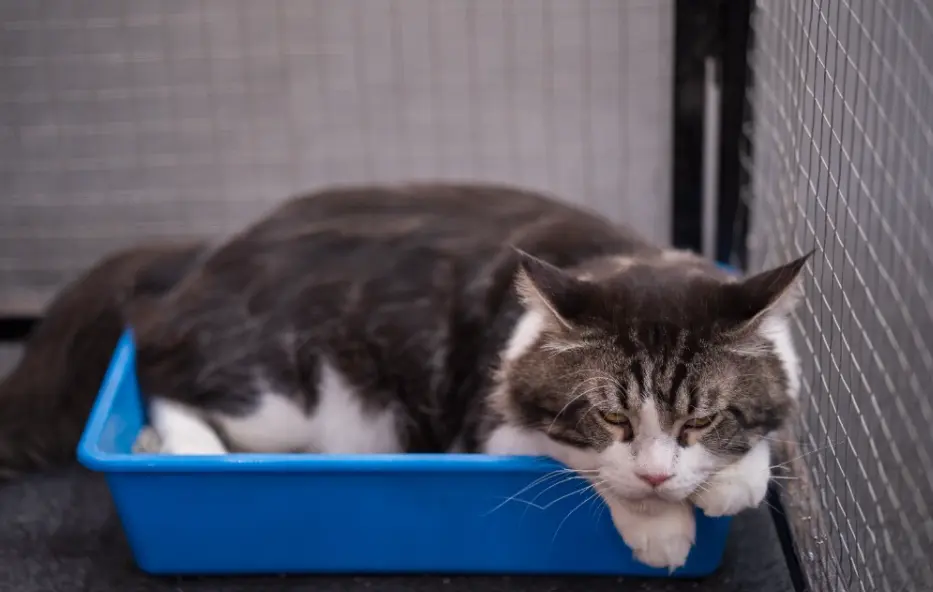
Myths about cat peeing on clothes that delay the fix
When a cat pees on clothes repeatedly, most owners waste weeks on the wrong solution because they believe one of these myths.
| Myth | Reality |
| My cat is doing it out of spite | Cats do not have spite. There is always a specific cause |
| Neutering will fix it completely | Reduces marking but does not resolve medical or litter box causes |
| They just need retraining | If the cause is medical, behavioral training does nothing |
| Cleaning the clothes is enough | Cats can smell residual urine at concentrations humans cannot. Enzymatic cleaners are required |
| It will stop on its own | Without addressing the cause, the behavior almost always continues and worsens |
When standard advice backfires
- Punishing your cat — yelling or spraying water only adds stress, which makes the underlying problem worse.
- Moving the litter box to the wrong spot — near food, in another cat’s territory, or in a high-traffic area can create a new aversion to the box itself.
- Changing too much at once — new litter, new box, and new location all together makes it impossible to tell what actually worked.
Ignoring it and hoping it resolves on its own . if the cause is medical, the condition typically gets worse the longer it goes untreated, and in some cases can become a health emergency
How to stop your cat peeing on your clothes
Step 1: See a doctor first.
A urine test, blood test, and physical exam are a start. If the problem is medical, behavioral solutions won’t work, no matter how hard you try.
Step 2: Use an enzymatic cleaner on everything.
Cat urine contains proteins that normal detergents cannot break down. Soak soiled clothing in an enzymatic cleaner before washing and use the same cleaner anywhere the urine has gotten.
Step 3: Fix the litter box situation.
Clean the box at least once a day. One box for each cat and one extra that’s three boxes for two cats. Use unscented, fine-grained litter. Make sure the box is big enough for the cat to move around comfortably. And keep it in a place that is quiet, easily accessible,
Step 4: Remove the target.
Do not leave clothes lying on the floor. Use a lidded basket. If the cat can’t reach the clothes, it can’t pee on them. This will help break the habit
Step 5: Reduce stress.
Recognize and mitigate recent changes in the home. Give the cat a safe place — a room or loft where it feels comfortable. Use the Feliway Pheromone Diffuser for at least 2-3 weeks.
Step 6: Address the marking issue separately.
If territorial marking is the cause, neutering or spaying is the most effective long-term solution. For cats that have undergone surgery and are marking due to competition from other cats, separate feeding areas, additional litter boxes, and separate sleeping areas will reduce competition.

For owners who’ve tried everything a structured approach
If you’ve made changes and the problem still hasn’t been resolved, a systematic approach is needed, rather than random interventions.
Days 1-3: Just observe.
Note whose clothes are on target, when it happens and whether the cat sits and urinates or sprays on a vertical surface. Write everything down the pattern will tell you the real reason.
Days 4-7: If you haven’t seen a vet yet, see one.
Even if you think there’s a medical reason for the behavior it’s important to rule out a medical reason first. Only then move on.
Days 8-14: Change one variable at a time.
Basic rule: Never change too many things at once, or you won’t know what helped. Change one thing, wait 5-7 days, see the result, then take the next step.
Conclusion
Check for medical reasons first don’t ignore them. Then see Litter Box.
In my experience, most cases resolve after the litter box situation is corrected or the medical cause is treated.
Cats that continue to do this after this usually have a stress factor that will take more time and patience to resolve. Your cat isn’t trying to make your life difficult . she’s trying to tell you something she can’t say any other way.
Frequently asked questions (FAQ)
Q: How do I stop my cat from peeing on clothes?
A: See a doctor first to rule out medical causes. Then fix the litter box clean it daily, increase the number of boxes if there are more than one cat, use unscented fine-grained litter. Do not leave clothes on the floor, put them in a basket with a closed lid. Clothes that are already soiled use an enzymatic cleaner, as ordinary detergents leave behind an odor residue that the cat will return to.
Q: Why does a cat pee on its owner’s clothes?
A: There are three main reasons. First medical problem: If there is an infection, cystitis or gallstones, sitting in the litter box is painful and the cat seeks a soft spot. Second litter box problem: dirty box, wrong litter, wrong place, or box too small. Third Stress: Your clothes smell like you, and a stressed cat comforts itself with your scent.
Q: How do I stop my cat from peeing on my things?
A: Block access to things first clothes in a closed basket, bedroom door closed. Clean everything with an enzymatic cleaner. Fix the litter box situation. If the behavior has started suddenly see a doctor first. Wait 5-7 days after each change then take the next step. Most cases resolve within 2-3 weeks with persistent effort once the root cause is identified.
Q: What scents deter cats from peeing?
A: Lemon scent is the most effective natural deterrent cats hate the smell of lemons, oranges, and grapefruit. White vinegar also works. Pet stores carry lemon or eucalyptus sprays that can be sprinkled near the laundry. Warning: Never use strong chemical sprays near the litter box their smell can make the box unpleasant and worsen the problem.
Q: Why does my male cat pee on my clothes specifically?
A: Male cats are more prone to both urinary blockages (which need urgent vet attention) and scent-based marking. If your cat only targets certain clothes, scent is likely the driver testosterone affects how strongly a cat reacts to a person’s scent, which is why male household members’ clothes are targeted more often.
Q: Why does my cat pee on my boyfriend’s clothes and not mine?
A: This is almost always about scent, not dislike. A new or less-familiar scent in the house a partner who doesn’t live there full-time, for example reads as unfamiliar territory to your cat, and marking is how it processes that. It typically settles down as the scent becomes familiar, especially if the litter box situation is otherwise solid.
Q: Why is my cat peeing on my clothes all of a sudden?
A: Sudden, out-of-nowhere peeing on clothes is usually the clearest sign of a medical problem such as a urinary tract infection, bladder stones, or FLUTD. If this behavior started recently and wasn’t happening before, see a vet before trying any behavioral fixes it’s the fastest way to rule out pain as the cause.
