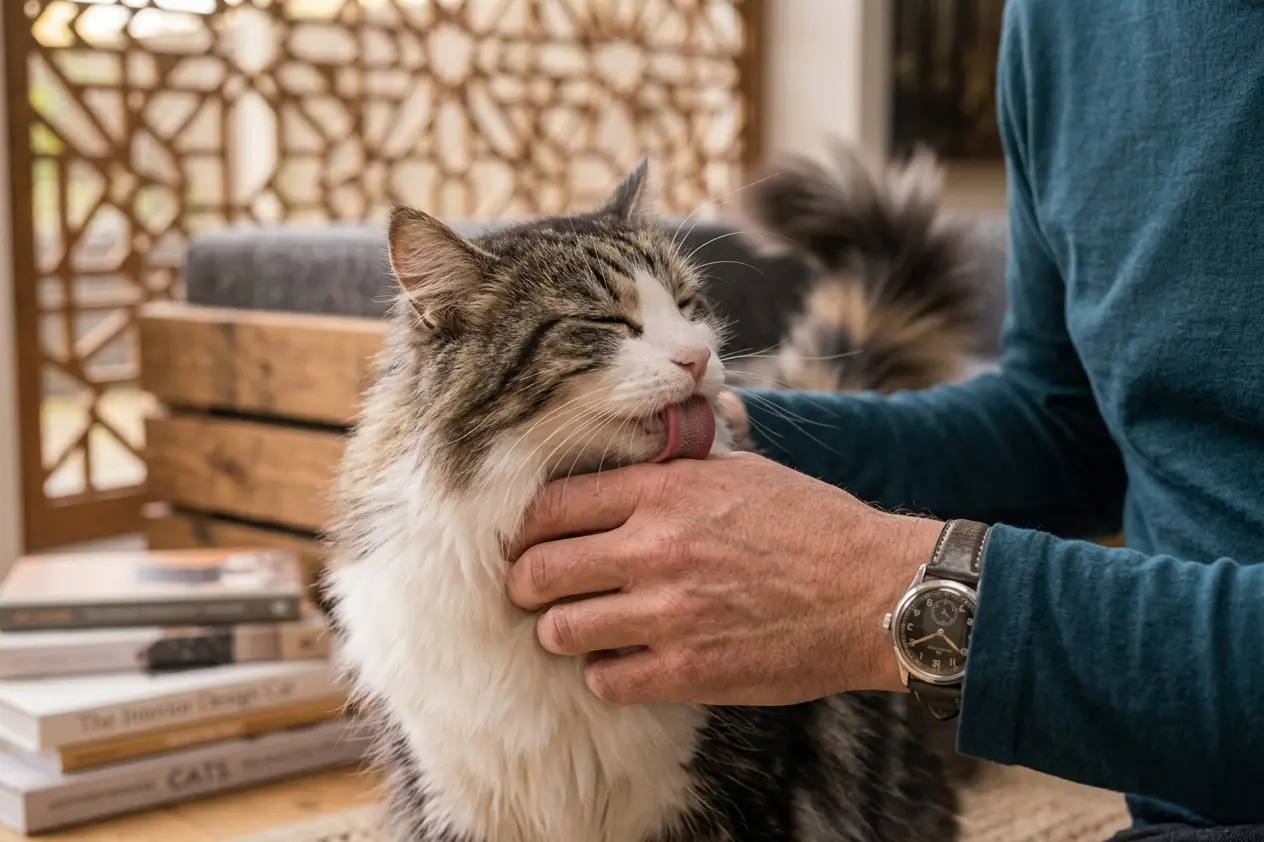
The simple answer is that it’s a way of showing affection, but there are other reasons as well. When a cat licks you, she’s making you part of her social group, as cats scent-mark those they’re close to by licking. It’s also a way of getting attention; if you ignore her, she’ll start licking so you can see her.
And sometimes it’s a way of soothing herself, especially if she’s upset or anxious, as licking helps her calm her mind.
In most cases, this is perfectly normal, but in some cases it’s worth paying attention to like if she’s licking excessively or harming herself.
My cat does this regularly when I’m reading. She starts licking my hand, then slowly moves up to my arm, and then looks at me as if I’m grateful for the favor.
The rubbing of his tongue like sandpaper is quite distinctive, and I’ve had cats my whole life, but this habit still makes me laugh.
So what’s really behind it he explains further.
Why does my cat lick me so much? 8 real reasons
1. She’s grooming you as a social act
Cats groom each other, a process called allogrooming. This strengthens the bond between them, makes the group smell the same, and builds trust.
When your cat licks you, she’s doing the same thing to you. She’s including you in her circle.
According to a study published in Applied Animal Behaviour Science, the more dominant cat in a multi-cat household is the one who takes the initiative to groom the others.
So if your cat is licking you regularly, it could also mean that she’s decided that she’s the senior member of the household, and you’re the one who needs to be groomed.
It’s not because she thinks you’re dirty. It’s because you’re part of her group, and she’s naturally taking care of you.
2. She’s showing you genuine affection
Licking is the first and most consistent way cats show affection. Mother cats lick their kittens from birth to provide warmth, to stimulate, and to bond. This attachment is deeply ingrained in the feline nature.
When your cat licks you, that’s often what she’s showing. You’re someone she feels truly safe with.
This licking is like hugging her with her tongue.
This is especially evident when she licks you in quiet moments when you’re lying still, reading, or just sitting still.
Your cat isn’t asking for anything. She’s just showing that she’s happy to be near you.
3. She’s making you part of her territory
Cats have scent glands in their mouths, chins, faces, and paws.
When she licks you, she’s leaving her scent on you, marking you as her territory and part of her social group.
This is why a cat in a multi cat household will lick one person more than the other.
The cat that licks you the most is often proving that you belong to her.
The other cats in the house will smell her scent on you and understand the social order.
It’s a form of possessive behavior, but in the sweetest way possible. Your cat has decided that you belong to her.
4. She wants your attention right now
Why does my cat lick me more at certain times, like when I sit down, pick up the phone, or start a task? That’s because licking works.
If your cat has licked you before and received attention in return, affection, eye contact, talking, she’s learned that licking is a successful strategy.
She’ll repeat this pattern whenever she wants attention from you.
This is accidental positive reinforcement you didn’t intentionally teach your cat to lick for attention, but you probably did.
5. Your skin tastes really interesting to them
Human sweat contains salts, sugars, and minerals, and cats have much more sensitive tongues than humans.
In addition, lotion, sunscreen, food residue, or the scent of something you’ve touched all make your skin lickable.
An important note from Dr. Alison Gerkin: Never let your cat lick an area where you’ve recently applied a topical product.
Some lotions, medications, and skin treatments contain ingredients that can be toxic to cats.
If you’ve applied something to your skin, keep the area away from your cat until it’s fully absorbed.
6. She’s comforting herself from stress or anxiety
Licking is a displacement behavior an action that cats do when they are anxious or overwhelmed.
Most often, this manifests itself in the form of excessive licking of themselves, but it can also be directed at you.
If your cat licks you intensely after something stressful a loud noise, a visitor, a change in the house she is calming her nervous system through the physical act of licking.
You are a safe place for her, and licking you is a source of comfort for her.
It is not dangerous in itself, but it should be monitored if the licking becomes excessive, compulsive, or accompanied by symptoms such as hiding, self-harming grooming, or changes in appetite.
This is why some cats also meow at night — when they are anxious or restless, meowing can also be a displacement behavior, just like licking. If your cat meows at night for no apparent reason, it may be expressing its stress in this way.
7. She’s seeking the comfort of nursing as a baby
Cats that wean before 8 weeks of age may continue to have comforting oral habits into adulthood.
Licking, sometimes accompanied by kneading and wheezing, mimics the experience of nursing.
According to Dr. Alison Gerkin, this type of licking is associated with the comfort of infancy and is more common in cats that were separated from their mother early.
It’s not harmful; it’s your cat finding comfort in a behavior that’s innately protective and nurturing.
If your cat kneads you while licking, that’s the clearest sign that this is the case.
8. Licking releases endorphins in your cat’s brain
This is an understated but really interesting reason.
Licking releases endorphins in cats the same fee good chemicals that are produced by grooming.
This means licking you isn’t just about you it feels good for your cat physically, too.
When this endorphin cycle is combined with your positive response, you caress, talk, give attention the behavior is reinforced on both sides.
Your cat licks you because it feels good for him and it gets a good result from you.
This is why and since cats already have strong bonds with their owners, licking can be very common among them this behavior feeds itself.
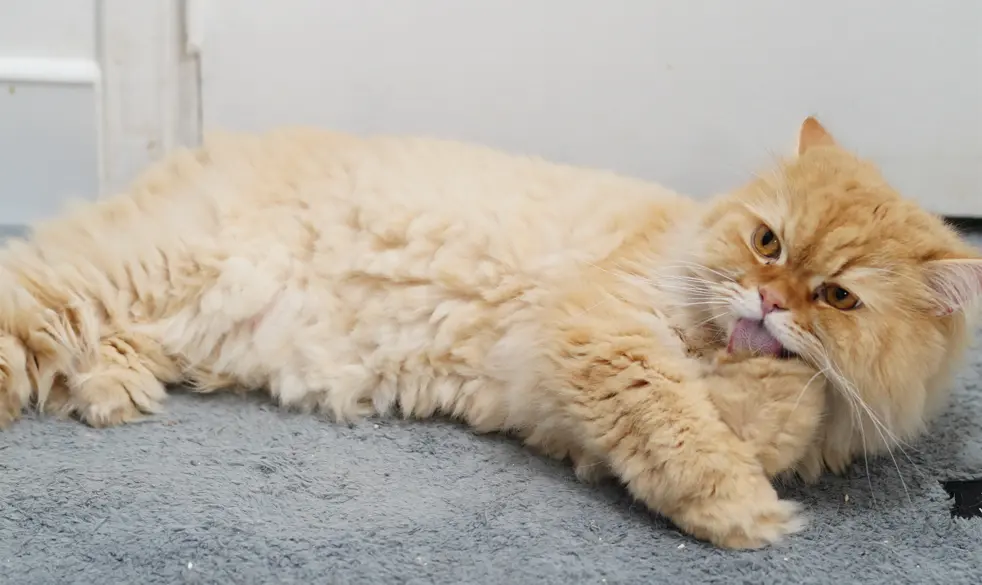
Why does cat licking feel like sandpaper?
That’s because a cat’s tongue is covered in hundreds of tiny, barbed spines called papillae.
These spines are made of keratin the same material found in human fingernails — and have hollow ends, which allows them to pump saliva deep into the hair as they groom.
The main function of these papillae is to remove dirt from the hair, spread skin oils, and regulate body temperature through evaporation.
When your cat licks you, the same structure that makes them so good at grooming feels like sandpaper on your skin.
A 2018 study published in the Proceedings of the National Academy of Sciences found that the papillae on a cat’s tongue have a unique curved, spoon-like structure that is much more effective at spreading saliva than previously thought and the same structure that makes grooming effective also makes it rough for you.
Why does my cat lick different body parts?
The location your cat chooses to lick is not random.
Your hands and fingers — Your hands are the most scented of all the things you’ve touched. And it’s your hands that do the most work for your cat — feeding, petting, and grooming. When your cat licks your hands, it’s often a combination of scent reading and gratitude.
Your face — Face licking is a very trusting behavior, as cats don’t put their faces in front of anyone. If your cat licks your face — especially near the eyes or mouth — she’s treating you in the same way that cats with strong bonds treat each other.
Your hair — Human hair has a very similar texture to cat hair, and the scent also lingers deep in the hair. Your cat is grooming your hair in the same way she would groom her childhood feline companion.
Your feet or legs — Feet and legs collect the most scent from the environment, as they carry the scent of wherever you go throughout the day. To your cat, your feet are a diary of your scent throughout the day, and she’s reading it.
When licking becomes too much the warning signs
Most cat licking is normal but there are certain patterns that indicate it needs attention.
Case 1 — When licking becomes compulsive: Your cat can’t stop, no matter what’s going on around them.
Case 2 — When licking involves excessive grooming: Your cat may lose hair, develop red skin, or develop sores, and all this is accompanied by licking toward you.
Case 3 — When the behavior starts suddenly and for no apparent reason: A cat that didn’t lick before suddenly starts licking — may be signaling discomfort or illness.
Case 4 — When licking is focused on a specific part of your body: This can sometimes be a sign that your cat is picking up on something through your scent that you’re unaware of — including illness. This is based on personal experience only, but it has been reported so consistently that it cannot be ignored.
If the licking is so severe that it causes hair loss or skin lesions, a veterinary examination is necessary. Causes may include allergies, parasites, neurological problems, and anxiety disorders.
Source: Cornell University College of Veterinary Medicine — Cats That Lick Too Much. https://www.vet.cornell.edu/departments-centers-and-institutes/cornell-feline-health-center/health-information/feline-health-topics/cats-lick-too-much
Myths about cat licking most owners believe
| Myth | Reality |
| My cat licks me because I taste good | Taste is one reason but rarely the primary one bonding and social grooming are more common drivers |
| Licking means my cat is hungry | Sometimes, but licking is far more often affectionate or social than food-related |
| My cat thinks I’m dirty | They know you are not. Allogrooming is about bonding, not cleanliness |
| It is always safe to let your cat lick you | Usually yes , but not if you have open wounds, skin conditions, or have recently applied topical products |
| Excessive licking is just a habit | Compulsive licking is often medical or anxiety-related and needs veterinary evaluation |
Is it safe to let your cat lick you?
Generally yes, but there are three important exceptions.
First, never let your cat lick open wounds, cuts, or scrapes, as cats’ mouths carry bacteria — most commonly Pasteurella that can cause infections through broken skin, and the risk is even higher for people with weakened immune systems.
Second, don’t let your cat lick areas where you’ve applied any topical products, as some lotions, sunscreens, medications, and skin products contain ingredients that are toxic to cats if a cat licks enough of something that contains salicylate, zinc, or certain essential oils, it can cause serious harm.
Third, don’t let your cat lick your face near your mouth, nose, or eyes, but this is mostly a precaution rather than a hard rule the reason for this is not toxicity but the risk of germ transfer, so it’s a reasonable precaution rather than a hard and fast rule.
How to Stop Your Cat from Licking: Methods That Really Work
First of all, never punish your cat, because scolding, spraying, or pushing him away creates stress, and stress can increase licking as the cat uses it to soothe itself, and it also breaks the trust between you.
Instead, when the cat starts licking, quietly get up and go into another room, break the physical contact without any dramatic reaction, because this way the cat will gradually learn that the licking means you are gone, and he will adjust.
If the cat is licking for attention, redirect his energy elsewhere as soon as he starts licking. Bring a stick toy or a feather teaser in front of him and start playing, because this will shift his attention to another activity.
Another option is to completely ignore the licking, no eye contact, no words, no affection because this neutral response removes the reward for licking, but remember that this requires the agreement of all household members.
And most importantly, if the cat is licking excessively due to boredom or anxiety, it needs to be kept more occupied: cat trees, puzzle feeders, rotating toys, and at least fifteen minutes of dedicated play per day all of which will reduce its need to lick.
Conclusion
Cats are stingy about sharing their affection they don’t lick everyone. If your cat specifically licks your hands, arms, or face, it means you’ve found a place in their social circle that not everyone else gets.
There is a real answer to the question “Why does my cat lick me so much?” bonding, grooming, territory, comfort, attention, endorphins. it’s rarely just one reason, but almost always a combination of all of the things your cat feels about you.
Yes, sandpaper like tongue isn’t always comfortable, but what it does reveal, it really is.
Frequently asked questions (FAQ)
Q: Is a cat happy when it licks you?
Ans: Usually yes. When a cat licks you, it means it feels calm, secure, and connected to you especially if it purrs and is in a relaxed state while licking. But if it licks when it’s stressed or anxious, it’s not okay to say “happy” it’s still a way of comforting itself, not being angry with you.
Q: How do you know if a cat is bonded to you?
Ans: A cat that is bonded to you will lick you, follow you from room to room, sleep near or on top of you, wink at you, and greet you when you return home. When it’s upset, it will specifically seek you out instead of hiding. Licking is the most obvious sign because cats only groom their trusted companions this way.
Q: How do you say “I love you” in cat language?
Ans: Wink. Give your cat a gentle wink, then slowly close and open your eyes, and look away slightly. Cats do this with people and animals they feel completely safe with and most cats will give you a slow wink back in response within seconds. Try it tonight when your cat is calm it really works.
Q: What is the 3-3-3 rule?
Ans: This rule isn’t directly related to licking it’s for newly adopted cats. They’re overwhelmed for the first 3 days. They start to feel more at home after 3 weeks. They feel more at home after 3 months. If your cat is already licking you they’re well past that stage.
Verified sources:
- Van Belle MJR et al. Applied Animal Behaviour Science. 2025. DOI: https://doi.org/10.1016/j.applanim.2025.106862
- Cornell University College of Veterinary Medicine — Cats That Lick Too Much. https://www.vet.cornell.edu/departments-centers-and-institutes/cornell-feline-health-center/health-information/feline-health-topics/cats-lick-too-much
- Yin S et al. “Tongue papillae structure in cats.” PNAS. 2018. DOI: https://doi.org/10.1073/pnas.1809544115
- American Association of Feline Practitioners — Feline Behavior Guidelines 2024. https://catvets.com/guidelines/practice-guidelines/feline-behavior-guidelines
