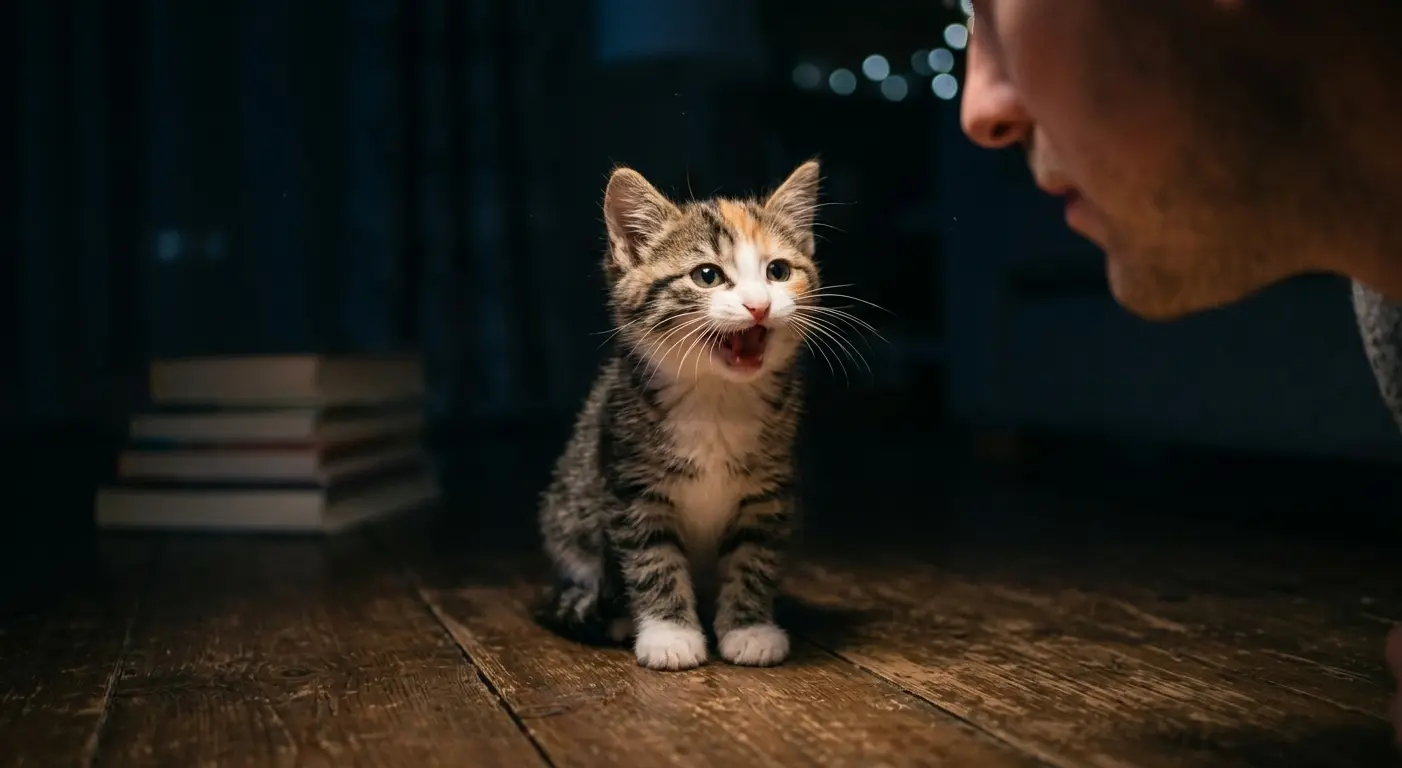
Hunger, energy left over from sleeping all day, the natural habit of moving around in the evening and morning, and stress. In older cats, it can also be a sign of thyroid or mental illness.
My cat does the same thing. She sleeps all day like she has no responsibilities. And as soon as midnight hits, she meows so much that the whole house gets fed up with her. So what is it, and how can I stop it?
Quick Reference: What Your Cat’s Age Tells You
| Cat’s Age | Most Likely Cause | What Usually Works |
| Under 1 year (kitten) | Excess energy, adjusting to new surroundings | Set a routine, bedtime play — kittens adapt within weeks |
| 1–7 years (adult) | Boredom, hunger, attention-seeking, and mating instinct | Fix mealtimes, add playtime, adjust environment |
| 8+ years (senior) | Thyroid, cognitive decline, high blood pressure, and hearing loss | See a vet first behavioural fixes rarely work until the medical cause is treated |
Why does my cat meow at night? 8 real causes
1. Cats are built for twilight, not bedtime
Cats are naturally most active around dawn and dusk, not exactly midnight, but close enough to disrupt your sleep. This instinct traces back to wild ancestors who hunted in low light, when prey was active, and predators were harder to spot.
That internal clock is still running in your house cat. When the house goes quiet and the lights go off, something in its brain registers it as time to move and meowing is often the sound of that instinct switching on.
Young cats and kittens are especially prone to this. Most adapt closer to their owner’s schedule as they mature.
2. They’re hungry and your timing is off
A cat that eats its last meal at 6 p.m. is really hungry by 2 a.m., and that hunger quickly turns into meowing.
Cats learn very quickly that meowing at night gets the job done. If you’ve ever gotten up at 3 a.m. to go to the kitchen to quiet down, your cat has learned that this is a successful strategy and she’ll use it again.
The solution: Feed her last meal closer to bedtime. Or use an automatic feeder that dispenses a small amount of food at 3 or 4 a.m. That way, you’re out of the equation, the machine feeds, not you and meowing at night becomes pointless.
3. They slept all day and have energy to burn
If your cat sleeps 14 to 16 hours a day, which is perfectly normal for house cats. She’ll have a lot of pent-up energy by evening, ready to be released.
With no way to release that energy, meowing becomes her way of getting active. She wants to play, chase, hunt, and you’re the only thing she has available.
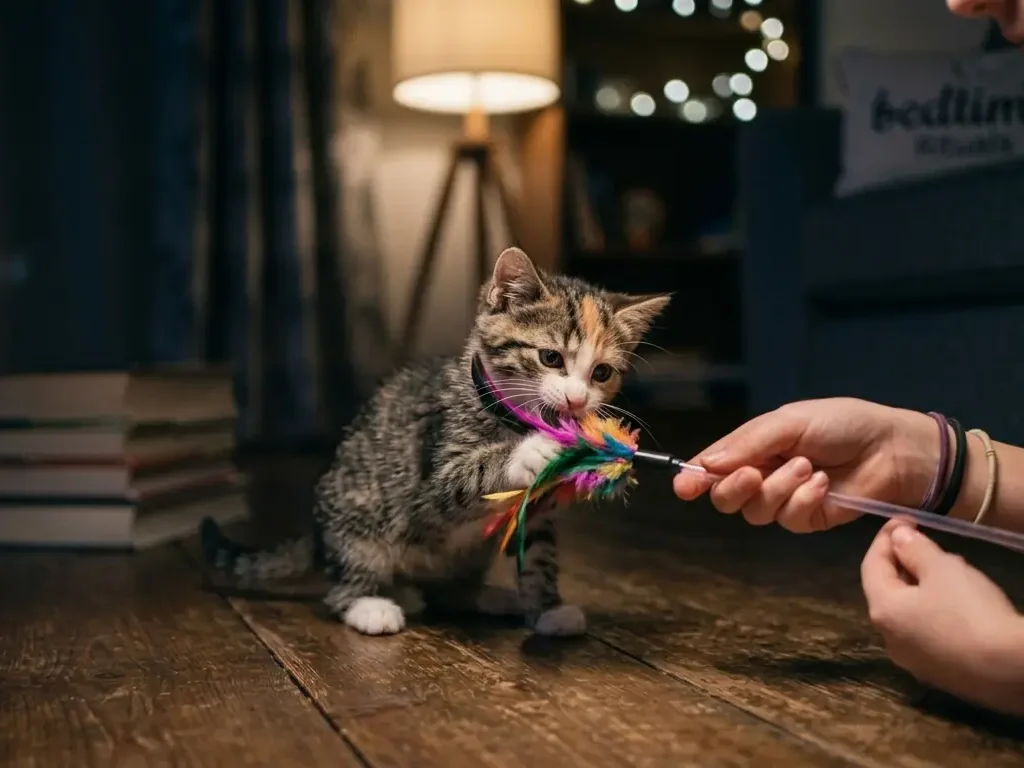
A good 15 minutes of play before bed, especially with a stick toy, makes a big difference. Get her really tired, then give her a little treat. This way, the natural cycle of hunting, eating, grooming, and sleeping is established, greatly increasing her chances of getting a good night’s sleep.
4. Something in their environment is triggering them
Cats have a much sharper sense of hearing than humans. A raccoon walking by at 2 a.m., a car coming from outside, a breeze blowing through an open window, or a neighbour’s TV playing all of these can be perceived as a threat to a cat.
Streetlights and outdoor motion-sensor lights can also trigger their territorial instincts through windows. They see movement outside and meow in response to an intruder.
Blackout curtains are really effective. And so is white noise, which blocks out the outside sounds that trigger them. These two changes alone have solved the problem of nighttime meowing for many cat owners.
5. They want attention
Cats are very alert. If they’ve ever gotten attention by meowing at night, even if it’s negative, like you coming over and quieting them, they know it works.
That’s why the “ignore” advice is easier said than done. Once a cat learns that meowing sometimes gets the job done, it’s not going to stop. Experts call it an extinction burst. When you first start ignoring, the meowing will become even more intense, and then eventually stop.
But it requires everyone in the household to adopt the same attitude. If one person gives up, the cat will start again.
6. They’re stressed, or their routine has changed
Cats lean heavily on familiar surroundings. A new pet, a new person, rearranged furniture, a change in your work hours, or even an unfamiliar smell can all cause low-level stress, and it often surfaces at night, when the house is quiet.
A Feliway diffuser, which releases a synthetic calming scent, is genuinely effective for stress-driven nighttime meowing. Most owners notice a difference within 2–3 weeks. This kind of routine disruption is also behind cats suddenly following their owners everywhere, as both are ways cats respond to a shaken sense of security.
7. An unspayed or unneutered cat in heat
If your cat hasn’t had surgery and is meowing loudly at night, almost like a scream. This is the most likely cause. A female cat in heat makes a sound that carries far and attracts male cats. This isn’t a soft meow. It’s a repetitive, annoying sound that will continue until she’s spayed or her heat cycle is over.
Spaying or neutering eliminates this problem completely, and it’s also best for your cat’s long-term health.
8. A medical problem
My cat has suddenly started meowing at night, when it never did before.
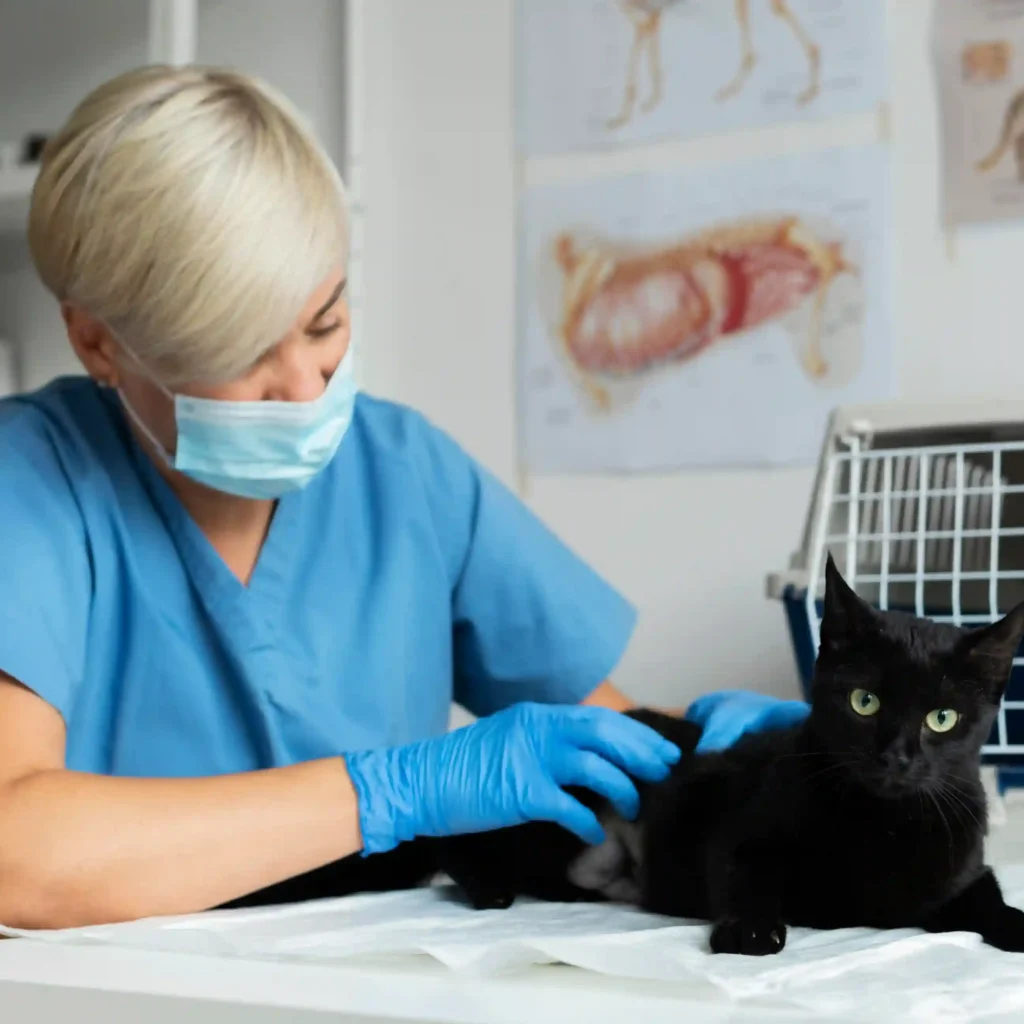
If this is the case, especially in an older cat, then you should definitely get it checked out by a vet, as there can be a number of medical reasons for this.
Why? When a previously quiet cat suddenly starts meowing at night, especially if it’s over 8 years old, it can be a sign of several treatable medical problems.
- Hyperthyroidism increased activity, appetite, weight loss, and loud nighttime meowing. Common in older cats and manageable with medication.
- Feline cognitive dysfunction is similar to dementia; affected cats can become confused or disoriented, especially at night, and meow because they feel lost in familiar surroundings. A dim nightlight near their sleeping area can help.
- High blood pressure can cause confusion and anxiety that shows up as a sudden, high-pitched, almost screaming sound many owners say they’ve never heard before.
- Urinary blockage, especially in male cats, is a life-threatening emergency. If your male cat is going to the litter box frequently at night and vocalising during or after, see a vet immediately.
A 2025 study published in the American Journal of Veterinary Research found that cats with inflammatory bowel disease meow significantly more and seek attention. If the meowing is new and sudden and doesn’t seem to be due to a behavioural cause, get your cat checked out.
Myths about cat meowing at night that most owners believe
Most online advice repeats the same things. Some of it is wrong. Here’s what actually holds up.
| Myth | Reality |
| Cats are nocturnal | Cats are crepuscular, dawn and dusk, not all night. Nocturnal is a common misunderstanding |
| Ignoring always works | Only works for attention seeking. For medical or anxiety causes, ignoring makes things worse |
| A fed cat won’t meow at night | Hunger is one reason. Hyperthyroid cats eat constantly and still vocalise intensely |
| Senior cats meow more it’s just aging | Nighttime yowling in seniors is almost always due to a medical issue. Treating it as “just ageing” delays necessary care |
| Letting cat sleep with you stops the meowing | For some cats yes. For cats with separation anxiety, it can worsen dependence in the long term |
When common advice backfires
Some common solutions create new problems, depending on the cat.
- A laser pointer before bed leaves the hunting instinct unresolved, since there’s nothing to actually catch, which builds frustration. Always follow it with a physical toy the cat can catch.
- An automatic feeder for every cat food-obsessed cat can become fixated on the machine itself and start meowing at it. A puzzle feeder works better for these cats.
- Closing the door on a cat with separation anxiety usually makes the anxiety worse, not better, and meowing at the door intensifies rather than eases.
- Getting a second cat to cure loneliness if the two cats don’t get along, stress increases, and nighttime meowing gets worse, not better. Introductions need real time.
- Ignoring meowing caused by thyroid disease, a medical cause, won’t resolve with behavioural tactics. Ignoring it only delays treatment.
Why does your cat wait until you’re almost asleep?
Cats’ natural energy peaks in the evening. When you lie down quietly, and the house is quiet, the cat’s brain interprets this as hunting time. Silence and stillness are hunting conditions for them.
It’s no coincidence that they wait for you to fall asleep. Your silence is their trigger. This same need for closeness also causes cats to follow you from room to room
Practically: Keep them busy in the early evening, not right before bed. It helps them better transition this energy surge.
How to stop your cat meowing at night
Adjust meal times. Give your cat her last meal 30-60 minutes before bedtime. A full cat will be quieter at night.
Feed her before bed. 10-15 minutes of active play with a stick toy, then her last meal. This will help her get into the routine of hunting, eating, and sleeping.
Try an automatic feeder. Set it to deliver a small amount of food at 3-4 a.m. The machine does the feeding, not you. The reward for nighttime meowing is gone.
Use blackout curtains and white noise. Block out outside visual stimuli and soften environmental sounds that trigger territoriality.
Install a Feliway diffuser. Synthetic pheromones for stress-related meowing reduce anxiety in most cats within 2-3 weeks. Use it consistently, not intermittently.
Never respond to meows. Don’t scold, don’t look, don’t feed. Any response teaches your cat that meowing is rewarding. The only exceptions are when you suspect a health problem.
Maintain a daily routine. Feed, feed, and talk to your cat at the same time every day. Cats with a regular routine will meow much less at night than those with irregular routines.
If you’ve tried everything but nothing works, try this 2-week schedule
If general advice doesn’t work, a proven method is needed rather than random tips.
Days 1-3: Just observe. Note the time, the reason, and what stops the meowing. Don’t change anything right away. Most people skip this and apply solutions without knowing the real cause.
Days 4-7: Change one thing at a time. Move mealtimes forward by half an hour. Add a new toy. Don’t change too many things at once — you never know what will help.
Days 8-10: Establish a bedtime routine. Same time, same order every night. Cats follow routines, not random play.
Days 11-14: Review. If the behaviour hasn’t improved by about 40%, stop the behavioural solutions and see a doctor. The cause is probably medical.
The most important rule: If you answer the cat even once during these 2 weeks, the whole account is ruined. Make sure to inform your family members about this plan.
Conclusion
My cat still does it, but much less than before because we’ve gotten into the pattern. She should be eating late at night and playing well before bed, not whenever I have time.
If she doesn’t and especially if the meowing is new, sudden, or the cat is getting older, it’s time to talk to the vet. Your cat isn’t trying to drive you crazy; she’s trying to tell you something. It’s just a matter of understanding what she’s trying to say.
Frequently asked questions (FAQ)
Q: My cat has suddenly started meowing at night when she never did before.
A: “Suddenly” is the keyword here. If your cat was previously quiet and is now meowing without any environmental changes, especially if she’s over 7 years old, it’s a good idea to get her checked out by a vet. Thyroid, high blood pressure, and dementia are common causes of sudden behaviour changes in older cats.
Q: Can stress cause a cat to meow at night?
A: Yes. A change in environment, a new pet, or a disruption in routine can all create stress that manifests as meowing at night. Feliway diffusers, a well-established daily routine, and more play and attention during the day are the most effective ways to deal with stressed meowing.
Q: How do I stop my cat from meowing at night?
A: Have their last meal close to bedtime. Play with a stick toy for 10-15 minutes before bed. If she’s meowing for attention, never respond, not even scolding. The same behaviour from everyone in the household works. Most cats adapt within 1-2 weeks.
Q: Should you ignore a cat’s nighttime meows?
A: Usually, yes, if it’s attention-seeking behaviour, responding reinforces it. But not always. If the meowing started suddenly, the cat is over 8 years old, or the voice is different from normal, check for a medical cause first. Ignore a habit, not a health signal.
Q: Why does my cat meow at 2 a.m.?
A: Three most likely reasons. Their evening and morning energy peaks near sunrise and sunset, 2 a.m. is pretty close. Or they’re hungry because their last meal was a long time ago. Or older cats could have thyroid or cognitive impairment. If it started suddenly and the cat is older, see a vet.
Q: Are cats happier sleeping with you?
A: Most cats are happy, yes. Sleeping near or on top of their owner reduces stress, provides warmth, and strengthens the bond. Research suggests that cats use their owner’s presence as a safe haven. The real question is whether it works for your sleep, but it does for theirs.
