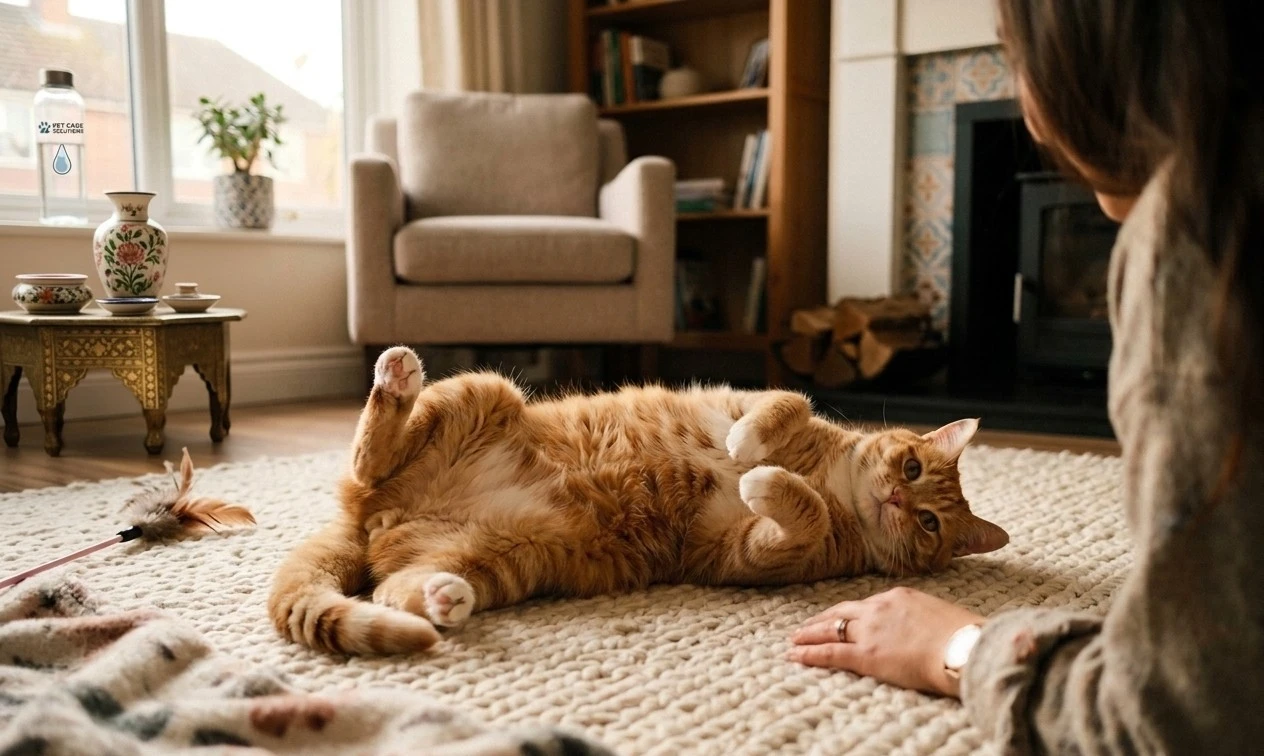
When your cat shows you its belly, the most common meaning is trust. Your cat may feel safe, relaxed, and comfortable enough to expose one of the most vulnerable parts of its body. However, showing the belly does not always mean your cat wants a belly rub.
Some cats roll onto their backs to greet you, stretch, cool down, play, ask for attention, or prepare to defend themselves. To understand the message correctly, look at the entire cat rather than focusing only on the exposed belly. The ears, eyes, paws, tail, posture, and situation will tell you much more.
Why is a cat’s belly vulnerable?
A cat’s belly protects important organs, including the stomach, intestines, kidneys, bladder, and liver. Compared with the back, the underside has less natural protection from bone and muscle, so cats instinctively guard it.
That is why a calm belly display can be meaningful. A cat that voluntarily rolls onto its back near you is placing itself in a position where it would be harder to escape danger. It may be communicating that it does not feel threatened in your presence.
The loose flap of skin along the lower abdomen is called the primordial pouch. It is a normal feline feature, not automatically a sign of being overweight. Experts suggest that it may support flexibility and provide some protection during movement, although it should not be treated as the only reason a cat exposes its belly.
What does it mean when your cat shows its belly?
In many situations, a belly display means your cat feels safe and comfortable. It may happen when you come home, sit beside your cat, begin speaking softly, or enter the room after your cat has been resting.
Your cat may be communicating trust, affection, or a desire to remain close. Other relaxed behaviors can support this interpretation, such as soft eyes, purring, slow blinking, kneading, or stretching out beside you.
A belly roll can also be a greeting. Some cats flop onto their backs when a favorite person appears, almost as if they are saying hello. This is usually a friendly social gesture, but it still does not automatically give permission to touch the stomach.
Does showing the belly mean your cat wants a belly rub?
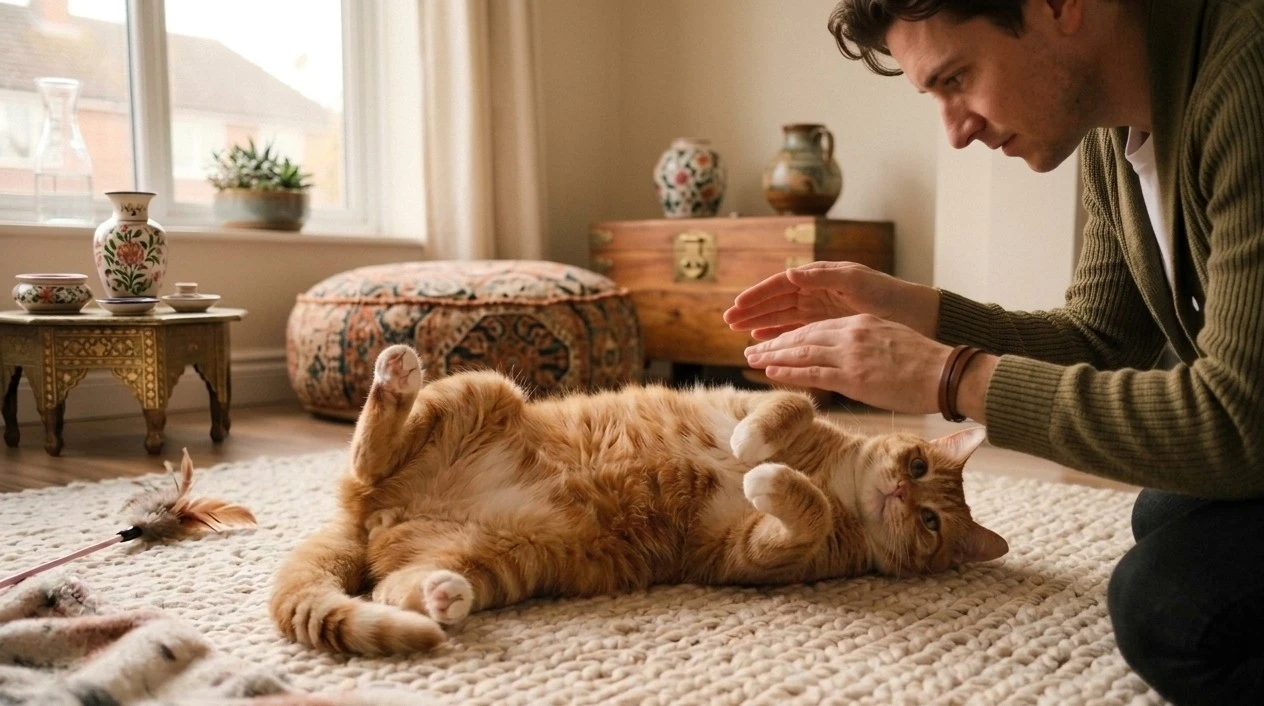
Usually, no. This is the most important distinction in this behavior.
For many cats, exposing the belly is a display of trust rather than an invitation to touch. Humans see a soft, fluffy stomach and naturally think the cat is asking for a rub. Cats may see the situation differently: they may be showing you that they feel safe while still wanting control over physical contact.
Some cats genuinely enjoy belly rubs. Others tolerate one or two touches and then become uncomfortable. Some dislike the sensation immediately. Every cat has individual preferences based on personality, socialization, past experiences, and sensitivity.
Why does my cat bite when I rub its belly?
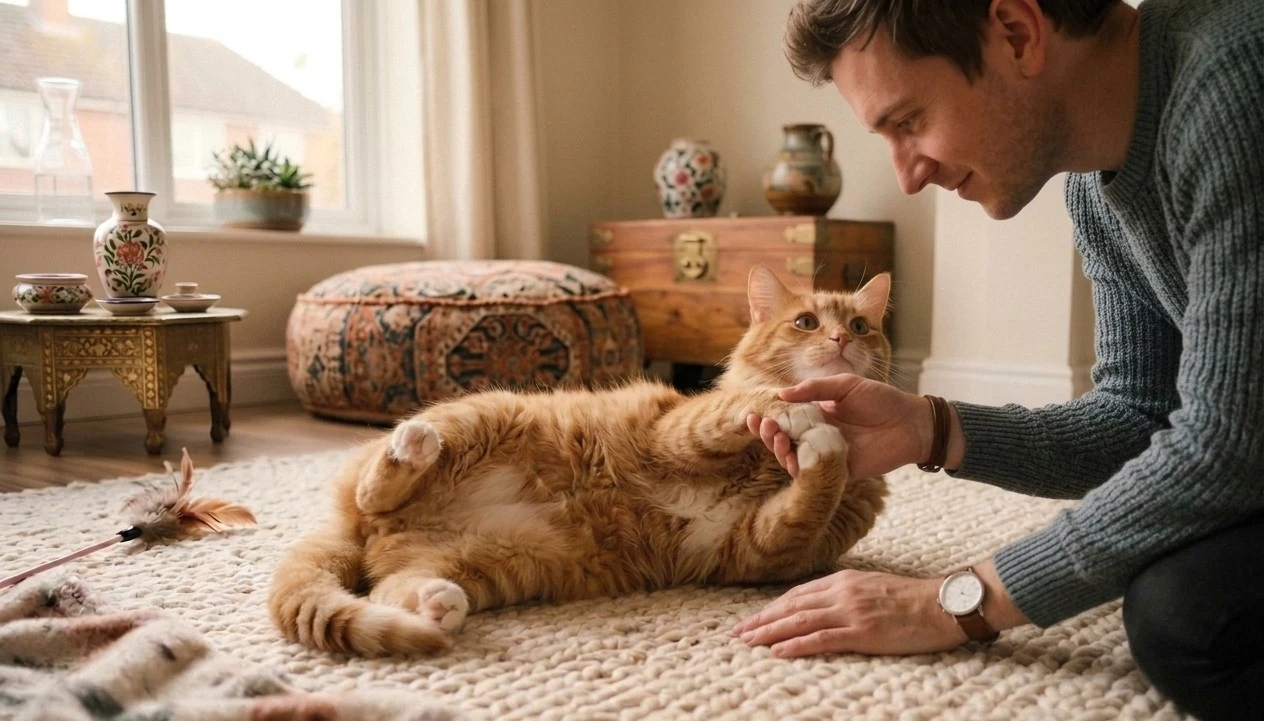
When a cat suddenly grabs, kicks, scratches, or bites after showing its belly, it is often reacting to a protective reflex. The cat may have relaxed its guard, but touching the vulnerable area can activate the instinct to defend it.
The belly can also be highly sensitive. Hair follicles and nerve endings may make the sensation feel irritating, ticklish, or overwhelming. What feels like gentle affection to a person can feel like too much stimulation to a cat.
This reaction is not usually betrayal or deliberate aggression. Your cat did not necessarily trick you. It may simply have been comfortable enough to expose the belly but not comfortable enough to have it touched.
If your cat catches your hand, stop the interaction calmly. Do not shout, hit, or punish the cat. Punishment can increase fear and make future defensive reactions more likely.
Do some cats enjoy belly rubs?
Yes, some cats enjoy them. A cat that genuinely likes belly contact will usually remain relaxed instead of becoming stiff or defensive.
Your cat may be comfortable with a brief belly touch if it stays loose, keeps its paws relaxed, continues to interact with you, and does not show signs of tension. Some cats may even lean into the touch or calmly reposition themselves to allow more contact.
Even then, do not assume that acceptance will always be the same. A cat may enjoy a short rub one day and reject it the next. Stop when the cat’s body language changes.
How can you tell if your cat wants a belly rub?
Look for the cat’s reaction rather than relying on the exposed belly alone.
| Body language | Likely meaning | Best response |
| Loose body, soft eyes, relaxed paws | Trust and comfort | Speak softly or offer a slow blink |
| Belly exposed while purring and stretching | Relaxation or greeting | Let the cat remain comfortable |
| Cat rolls over while playing with a toy | Play invitation | Use a toy instead of your fingers |
| Body stiffens when your hand approaches | Discomfort or sensitivity | Stop moving toward the belly |
| Tail begins twitching or lashing | Overstimulation or irritation | End the contact |
| Ears flatten and pupils widen | Fear or defensive mood | Give the cat space |
| Paws close around your hand | Defensive or playful grabbing | Withdraw calmly |
Purring alone is not enough evidence that the cat wants a belly rub. A cat may purr while feeling stressed or overstimulated, so always consider the full context.
Other reasons cats show their belly
Trust is an important reason, but it is not the only one.
Stretching and getting comfortable
Cats may roll onto their backs to stretch after sleeping or resting. They may extend their front legs, twist their spine, and move their back legs before settling down again.
In this situation, the cat is not necessarily communicating with you. It may simply be loosening its muscles and finding a comfortable position.
Playing
Young cats and kittens often expose their bellies during play. They may roll over to grab a toy, kick with their back legs, or prepare to wrestle.
This position can be part of a hunting-style game. Use a wand toy, stuffed toy, or ball rather than your hands. Letting a kitten attack fingers can teach it that human skin is an appropriate target.
Cooling down
A cat’s belly usually has less fur than the back. Exposing it on a cool floor or in a breezy area may help the cat regulate body temperature.
A belly-up cat resting on tile, near a fan, or in a shaded place may simply be cooling itself. This is normal if the cat looks comfortable and is breathing normally.
Asking for attention
Some cats learn that showing their belly makes people talk to them, offer a treat, or start a game. The behavior can become a learned way to request attention.
Watch what your cat does immediately afterward. If it walks toward the food bowl, toy basket, or a favorite person, the belly display may be part of a request rather than a request for physical contact.
Rubbing its scent
A cat may roll on its back or side to rub its scent onto a surface. The behavior can happen on a blanket, carpet, sofa, or a place where the cat likes to rest.
This is usually normal marking and comfort behavior. It does not necessarily mean the cat wants to be touched.
Being in heat
An unspayed female cat may roll more frequently when she is in heat. This can happen with increased vocalization, rubbing, restlessness, and raising the hindquarters.
If your cat is unspayed and shows sudden changes in rolling or vocal behavior, discuss reproductive care with a veterinarian.
Relaxed roll versus defensive belly-up
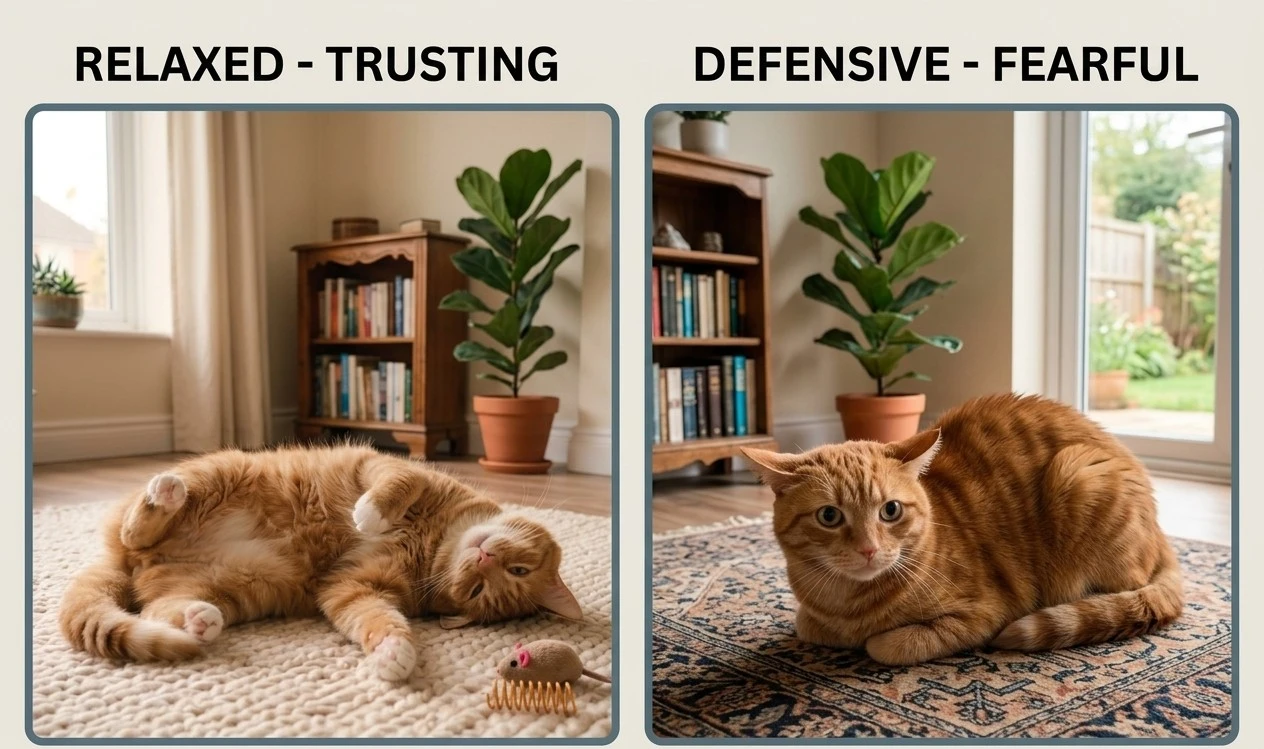
The same belly-up position can have two completely different meanings. A relaxed cat is comfortable and voluntary, while a defensive cat is preparing to protect itself.
| Feature | Relaxed belly display | Defensive belly-up position |
| Body posture | Loose and comfortable | Stiff and tense |
| Eyes | Soft or partly closed | Wide with enlarged pupils |
| Ears | Natural or forward | Flattened or turned backward |
| Paws | Relaxed | Claws exposed and ready |
| Tail | Still or gently moving | Lashing or rapidly flicking |
| Sound | Quiet, purring, or calm | Hissing, growling, or loud distress |
| Situation | Calm interaction or rest | Fear, confrontation, or restraint |
| Response | Respectfully acknowledge | Move away and give space |
A defensive cat is not necessarily being submissive. Rolling onto its back can allow the cat to use all four paws and its teeth if it feels cornered. Never approach a tense, hissing, or clawed belly-up cat.
How should you respond?
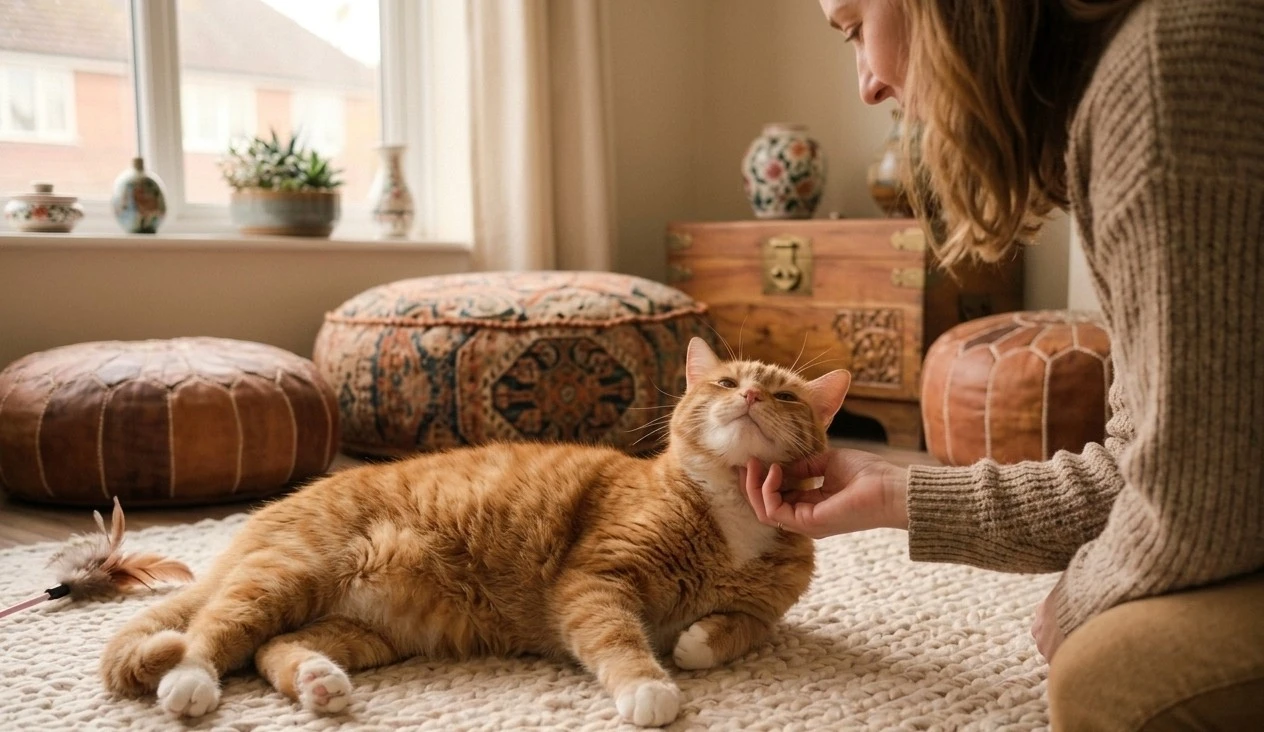
The safest first response is to appreciate the trust without immediately touching the belly. You can speak softly, slow blink, or gently stroke areas your cat already enjoys.
Most cats prefer contact around the cheeks, forehead, chin, and shoulders. These areas are often more comfortable than the stomach and contain scent glands involved in social communication.
If your cat clearly enjoys belly rubs, begin with a very brief and gentle touch. Watch for body tension, tail movement, sudden stillness, or paws closing around your hand. Stop at the first sign that the cat’s comfort is changing.
You do not need to touch the belly to strengthen your relationship. Respecting the area may actually communicate trust more effectively than forcing contact.
When should you be concerned?
Belly exposure is usually normal, but a sudden behavior change deserves attention. If a cat that never showed its belly suddenly becomes unusually defensive, sensitive, or aggressive when touched, pain or skin irritation could be involved.
Contact a veterinarian if the behavior occurs with hiding, reduced appetite, lethargy, limping, excessive grooming, swelling, a painful reaction, or other unusual changes.
A cat that appears uncomfortable when lying down or repeatedly guards one area of the abdomen may need a physical examination. Do not attempt to diagnose the cause by repeatedly touching the belly.
How else does a cat show trust?
A cat may show trust in several other ways. Sleeping near you means it feels safe enough to relax around you. Slow blinking suggests calm social communication. Kneading can reflect comfort and emotional security. Headbutting, cheek rubbing, following you, and choosing to stay in the same room can also show attachment.
Purring often accompanies positive interactions, but it can also occur during stress or discomfort. That is why no single behavior should be interpreted in isolation.
Conclusion
When your cat shows you its belly, the most likely message is trust and comfort. Your cat feels safe enough to expose a vulnerable part of its body near you, which is a meaningful social gesture.
However, an exposed belly is not automatically an invitation for a belly rub. Some cats enjoy stomach contact, while others find it uncomfortable or overly stimulating. Read the whole cat, respect its boundaries, and choose gentle interaction around the cheeks, chin, forehead, or shoulders when the belly is not clearly welcome.
Frequently asked questions (FAQ)
Q: Why does my cat show me its belly when it sees me?
Ans: Your cat may be greeting you, showing trust, seeking attention, or feeling relaxed. If the body is loose and the eyes are soft, the behavior is usually positive.
Q: Does my cat show its belly because it loves me?
Ans: It may be a sign of affection and trust. A relaxed cat is showing that it feels safe enough to expose a vulnerable part of its body near you.
Q: Why does my cat show its belly but bite when I touch it?
Ans: The belly display may be a trust signal, not permission to touch. Contact can trigger a protective reflex, sensitivity, or overstimulation.
Q: Should I rub my cat’s belly?
Ans: Only if your cat clearly enjoys it. Start gently, observe the response, and stop immediately if the body becomes tense or the tail begins moving sharply.
Q: Why does my cat roll over during play?
Ans: Your cat may be preparing to grab, kick, or wrestle a toy. Use a toy instead of your fingers to prevent hand-biting habits.
Q: Is a cat lying on its back always relaxed?
Ans: No. A relaxed cat has soft body language, while a defensive cat may have flattened ears, wide pupils, exposed claws, and a stiff posture.
