

How much chocolate is dangerous for your dog depends on three things: your dog’s weight, the type of chocolate, and how much was eaten. A 10-pound dog can start showing signs from as little as 1.5 ounces of milk chocolate, while the same amount would barely affect a 70-pound dog but a single ounce of baking chocolate can be dangerous for that small dog. Dark chocolate and cocoa powder can be life-threatening even in small amounts, so do not wait to see what happens. Check the wrapper, note the time, and call your vet right away.
How Much Chocolate Is Dangerous for Your Dog?
There is no single safe number, because a dose that only upsets the stomach and a dose that can kill are very different things, and most tables online never say which one their number is. The honest way to judge it is by dose: milligrams of theobromine and caffeine per kilogram of body weight.
| Dose (mg/kg) | What can happen |
| Under 20 | Signs unlikely |
| 20–40 | Mild to moderate signs: vomiting, diarrhea, restlessness |
| 40–50 | Severe signs: rapid heart rate, tremors |
| 60–80 | Seizures, tremors, coma |
| 100–200 | Possible death |
One warning about that top line: vet references disagree on the exact lethal dose some put it above 55 mg/kg, others at 100–200 mg/kg. Do not treat 55–100 mg/kg as safe. Treat anything above 40 mg/kg as an emergency.
The table below turns those bands into real amounts. Each figure is the amount that reaches about 20 mg/kg, where mild signs can start. It is not a safe amount. It is the point where you should already be on the phone.
| Dog weight | Milk chocolate | Dark / semi-sweet | Baking chocolate | Cocoa powder |
| 5 lb (2.3 kg) | 0.7 oz (20 g) | 0.3 oz (9 g) | 0.1 oz (3 g) | 0.06 oz (2 g) |
| 10 lb (4.5 kg) | 1.4 oz (40 g) | 0.6 oz (17 g) | 0.2 oz (6 g) | 0.1 oz (3 g) |
| 20 lb (9.1 kg) | 2.8 oz (80 g) | 1.2 oz (34 g) | 0.5 oz (13 g) | 0.2 oz (6 g) |
| 30 lb (13.6 kg) | 4.3 oz (121 g) | 1.8 oz (51 g) | 0.7 oz (19 g) | 0.3 oz (10 g) |
| 50 lb (22.7 kg) | 7.1 oz (201 g) | 3.0 oz (86 g) | 1.1 oz (32 g) | 0.6 oz (16 g) |
| 70 lb (31.8 kg) | 9.9 oz (281 g) | 4.2 oz (120 g) | 1.6 oz (45 g) | 0.8 oz (23 g) |
| 100 lb (45.4 kg) | 14.2 oz (402 g) | 6.0 oz (171 g) | 2.3 oz (64 g) | 1.1 oz (32 g) |
The calculation is simple: theobromine per ounce × ounces eaten ÷ weight. Milk holds about 64 mg per ounce, semi-sweet about 150 mg, baking chocolate about 400 mg, and cocoa powder about 800 mg.
Two worked examples show why weight changes everything. Take one standard milk chocolate bar, 1.55 ounces, holding about 64 mg of theobromine. A 10-pound dog that eats it takes in about 21 mg/kg, so mild signs can start. A 70-pound dog that eats the same bar takes in about 3 mg/kg, so signs are unlikely but still tell your vet. For comparison, a 50-pound dog could become equally sick from 8 ounces of milk chocolate or just 1 ounce of baker’s chocolate.
Why Is Chocolate Toxic to Dogs?
Chocolate contains theobromine and caffeine, two stimulants that dogs break down very slowly. In people, theobromine clears quickly. In dogs, it builds up, overstimulates the heart and nervous system, and irritates the gut.
The darker and more bitter the chocolate, the more theobromine it holds. From most to least toxic, the order is cocoa powder, then unsweetened baker’s chocolate, then semisweet and sweet dark chocolate, then milk chocolate, then cocoa bean hulls.
| Chocolate type | Theobromine per ounce |
| White chocolate | Under 1 mg |
| Milk chocolate | About 64 mg |
| Semi-sweet chocolate | About 150 mg |
| Baking chocolate | About 400 mg |
| Cocoa powder | About 800 mg |
| Cacao beans | 300–1,500 mg |
Real products make the difference concrete. A wafer chocolate bar holds about 49 mg of theobromine, a standard milk bar about 64 mg, and a 101-gram bar of dark chocolate (70–85% cocoa) about 810 mg. A small dark bar can carry more than twelve times the theobromine of a milk bar the same size, which is why “it was only a little bit” means very little without knowing the type.

Image: White, milk and dark chocolate bars with cocoa powder side by side on a wooden table
My Dog Ate Chocolate?
Do these five things in order. Treatment works best in the first couple of hours.
1. Take the chocolate away and stay calm.
Move your dog away from any remaining chocolate, wrappers, and crumbs.
2. Find the wrapper.
Note the exact brand, the weight of the bar, the cocoa percentage, how much is missing, and the time your dog ate it. A photo of the wrapper helps the vet more than a guess.
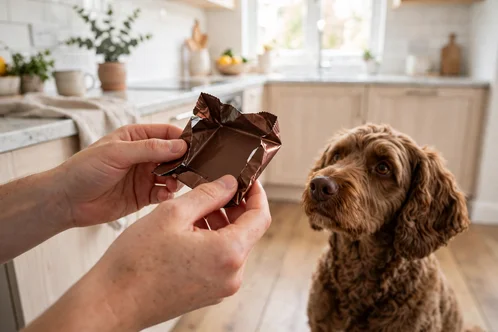
Image: Person reading a chocolate bar wrapper while a dog sits nearby in the kitchen
3. Check the fillings.
Raisins and macadamia nuts are toxic to dogs on their own. Sugar-free chocolate can hide xylitol, which can crash a dog’s blood sugar within 30 minutes, a separate emergency with its own symptoms and treatment. Tell your vet about every ingredient, not just the chocolate.
4. Call a professional now.
Call your vet, the nearest emergency vet hospital, the ASPCA Animal Poison Control Center at (888) 426-4435, or the Pet Poison Helpline at (855) 764-7661. Fees may apply. Have your dog’s weight, the chocolate type, the amount, and the time ready.
5. Do not wait for symptoms.
Chocolate poisoning is slow. A dog that looks fine at 30 minutes can be very sick at 6 hours, and that delay is exactly why “acting fine” fools so many owners.
Symptoms and When They Appear
Symptoms rarely start at once. Most dogs show them within 2–12 hours, though some take up to 24 hours, so plan for the widest window. Theobromine can stay in a dog’s system for up to 72 hours.
Early signs: vomiting, diarrhea, increased thirst and urination, restlessness, panting, and a fast heartbeat.
Severe signs: muscle tremors, wobbliness, a very high temperature, an irregular heartbeat, seizures, and collapse. Any severe sign is an emergency.
If your dog is acting fine, monitor like this: check every 30–60 minutes for the first 6 hours, then every few hours up to 24 hours. Keep fresh water available, keep your dog calm and indoors, and do not leave them alone overnight after a large ingestion. Write down anything unusual and call your vet the moment a sign appears. Acting fine is good news, not a clean bill of health.
When NOT to Induce Vomiting at Home
Never make your dog vomit unless your vet tells you to. Home vomiting can cause choking, inhaling vomit into the lungs, and worse injury if your dog is already seizing, unconscious, or drowsy, or has swallowed sharp foil. It is also far less useful after a couple of hours. Vets induce vomiting with apomorphine when it is safe and early enough, and that decision belongs to them.
Some dogs face higher risk than others. Puppies are small and still developing, so a small amount hits them harder. Senior dogs need extra care after any poisoning scare, because older hearts, kidneys, and livers clear toxins more slowly. Dogs with heart disease and pregnant dogs are also at higher risk, so tell your vet about any of these straight away.
What Will the Vet Do?
At the clinic, the vet may induce vomiting if the ingestion was recent and your dog is stable, then give activated charcoal to bind what is left in the gut. IV fluids help flush theobromine out faster, and the vet will monitor the heart, temperature, and blood pressure, adding other drugs as needed. Mild cases can sometimes be monitored at home, but only when your vet says so.
Cost varies widely with the treatment and the length of the stay. In the UK, treatment can run into hundreds of pounds, but ask your own clinic for an estimate first. The outlook is good when treatment starts early, and poor when a large dose is left for hours.

Image: Veterinarian gently examining a golden retriever dog on an exam table
How to Stop It Happening Again
Store chocolate in closed cupboards, not on low counters, and remember that dogs who steal food from counters can reach a lot more than you think. Keep bins closed and cocoa bean mulch out of the garden — it is made from the same toxic shells.
Teach a reliable “leave it” and reward your dog with dog-safe treats instead of sharing yours. Cats can be affected by chocolate too, with the same signs, so keep it away from them as well.
Key Takeaways
- Danger depends on weight, type, and amount small dogs and dark chocolate are the riskiest combination.
- Treat anything above 40 mg/kg as an emergency.
- Save the wrapper, note the time, check for xylitol, raisins, and macadamia nuts, and call your vet right away.
- Symptoms can take 2–12 hours to appear and theobromine can linger for up to 72 hours, so monitor a dog that seems fine for at least 24 hours.
- Never induce vomiting at home unless your vet tells you to.
Frequently Asked Questions
My dog ate a Twix bar. What should I do?
Treat it like any milk chocolate ingestion. Use the milk column in the table above, check how much of the bar is missing, save the wrapper, and call your vet with your dog’s weight and the time it was eaten.
How long does it take for a dog to get sick after eating dark chocolate?
Most dogs show signs 2–12 hours after eating it, and some take up to 24 hours. Watch your dog for at least 24 hours, and up to 72 hours after a large amount of dark chocolate or cocoa powder.
How do I flush chocolate out of my dog’s system?
You cannot do this safely at home. IV fluids at the vet help the body clear theobromine faster, along with activated charcoal and monitoring. Do not give your dog salt, oil, or anything to make them vomit unless your vet tells you to.
My dog ate chocolate 24 hours ago and seems fine. Should I still call the vet?
Yes. Tell the vet the type, the amount, and the exact time. Most dogs that were going to show signs will have done so by 24 hours, but the vet may still want to check your dog, especially after dark chocolate or cocoa powder.
Are there home remedies for chocolate poisoning?
No safe home remedy exists. The only safe home steps are removing the chocolate, saving the wrapper, and calling your vet. Anything else risks making the poisoning worse.
Can dogs eat white chocolate?
White chocolate holds almost no theobromine, so it rarely causes theobromine poisoning. Its high fat and sugar can still cause vomiting and stomach upset, so call your vet if your dog ate a lot of it.
